Showing posts with label irish times. Show all posts

16 June 2009

What is Patsy McGarry thinking?

Today's Rite and Reason article in the Irish Times, a regular Tuesday slot edited by that paper's Religious Affairs correspondent, Patsy McGarry, is quite jaw-dropping.

Rite and Reason, 16 June 2009

Some student who lives in Paris in an all-catholic hall of residence (anyone smell the signature aroma of the followers of Escrivá?) confidently tells us that Ireland and not the Catholic Church is responsible for the litany of abuse described in the Ryan Report . His basis for this view is that his breakfast companion at said hall of residence told him that 'I heard about Ireland on the news' referring to the publication of the report (presumably as opposed to 'I heard about the Catholic Church on the news").

This we are apparently to regard as proof that the French see the whole foul business as a peculiarly Irish rather than a Catholic problem.

Such incisive analysis is immediately succeeded by the sort of self-pitying craw thumping we have become used to from conservative catholic circles, which in turn is followed with a short recruitment advertisement for the priesthood ("In this climate, one wonders could God be calling some out there to serve in an experience of the church that has utterly failed to live the Gospel? Yes, God is calling and now more than ever we need young men to say 'Yes'" etc. etc.). I wonder if the repeated "Yes" is a reference to Bloomsday, the day on which day this excuse for a newspaper article was published. If so, then there we have the piece's only merit.

Eventually the writer reaches a conclusion. His formula for a better catholic church in the light of Ryan:
A simple return to Holiness
And his fervent hope:
we will have the courage to change
Are we to imagine that this the best that the collected imaginations of conservative Irish catholicism can come up with to respond to the report (I'm intentionally avoiding adjectives like "shocking" and nouns like "enormity" in relation to said report)? There is not a word about how a simple return to holiness is going to be of help to victims of abuse. Nor is there anything on what "we" need to have the courage to change into.

How in the name of all that's rational, reasonable, responsible and compassionate was this pap accepted for publication in the pages of the Irish national paper of record? It would (or, at least, should) have difficulty being printed in the Irish Catholic. After all, it's in the same category of unimaginative flailing about as the Mass Father Ted and his pals said when Dougal was trapped on a milkfloat with a bomb under it.

Patsy is a man who has done been good to me in his time and, more importantly, is an honourable and responsible journalist who has done more than most to help the victims of the abuse that Ryan reports on. But there's a series of related questions I'd like to ask him (apart from "What the hell were your thinking?"):

Would it be right for columns like Rite and Reason to retain their current format, style and content unaltered in the aftermath of Ryan? Was the publication of this article good for the column in the light of its revelations? Was it good for the Irish Times? Was it good for healthy, open discussion of religious matters in Ireland?

Lastly, was it good for the victims and for the healing of wounds among the innocent?

18 May 2008

Gray calling the kettle black

The following article is slight adaptation of something I put together and did the rounds with a few weeks ago (namely during Easter Week), when ace philosophical poseur, John Gray, was commissioned not one but two full-length opinion pieces in the Irish Times. It wasn't published in The Irish Times or anywhere else.

Now it may be that I can't write (please let me know if this is the case), but since no other article was later published to rebutt the poisonous tripe contained in the two Gray efforts, I feel the whole episode illustrates my previously expressed contention that people are allowed write any calumny they like in the Irish print media (and particularly in the Irish Times) without having to concede right of reply to those they insult, just as long as the lie is written for the benefit of 'belief'.


Philosophical poseur, Gray is best known for bad-mouthing the EnlightenmentThe flurry of anti-secular aggression written under the cover of Easter week in the Irish Times is illustrative of the level of absurdity that the debate on the role of religion in society has reached in Ireland. In holy week British celebrity philosopher, John Gray, had not one but two opinion articles hostile to atheism in the Irish paper of record (as usual, you may need to pay your dues to Geraldine to get these links to work). As well as his efforts, our own home-grown scourge of the secular, John Waters, put his oar in, as did Roman Catholic Orthodoxy’s defender of the faith, Breda O’Brien. And what was there in reply for the non-religious? Not a column inch outside of a single rather mild letter to the editor on Easter Saturday.

Blood libel
In his book-length rant against the Enlightenment, “Straw Dogs”, Gray rolled out the old blood libel that has become a weapon of choice for anti-secularists everywhere: i.e. that atheism was at least partially responsible for Nazism. He repeats this ridiculous accusation in the first of his IT articles. (Incidentally, this nasty piece of propaganda was since repeated without a squeak from the media by the Benedict during his visit to the US.) No argument does Gray present apart from the earth-shattering insight that the Nazis foully perverted the discoveries of Darwin to justify their extraordinary savagery.

Gray (and, shamefully, Benedict too) seems to know very little about the history of Nazism, which owed as much to pagan and Christian religious traditions as it did to atheism. Indeed National Socialism’s ideology was informed more by nostalgic anti-enlightenment romanticism than ever it was by any great enlightenment philosophers, as any study of proto-Nazi movements in 19th and early 20th Century will clarify. Indeed it seems it was mainly this Nazi yearning for a non-existent past that attracted the philosopher Heidegger to the ranks of the Hitler’s party (though ambition also surely played a role). It’s ironic now that the same Heidegger is one of the two or three world philosophers most cited by the Irish religious intelligentsia as leaving open a space for religion in a post-enlightenment world.

Schoolyard taunts
Gray’s case against memetics is even worse. Memetics is Richard Dawkins' exploration of the relatively modest and thought-provoking idea that genes may not be the only information storage systems in the world that both affect human behaviour and are capable of reproduction and variation, and are therefore also subject to their own evolutionary pressures. Cultural change, suggests Dawkins, may also be fruitfully be analysed in a similar way, where the concept of genes is replaced by what he calls "memes", which we are to interpret as ideas, opinions, beliefs and other mental artefacts that may be more or less effective in reproducing themselves via communication between human minds. Gray doesn’t even bother to argue with him. Indeed his attack is little more than a series of schoolyard taunts.

In fairness, maybe Gray is responding to Dawkins’ unfortunate metaphor for “memeplexes” (including religious memeplexes) as “viruses of the mind” (this expression has indeed led to much misunderstanding – especially when some of Dawkins’ other undiplomatic pronouncements are added to the mix). However, in neither his books nor his newspaper articles does Gray let us in on his reasoning on the merits of the theory. He limits himself to thumbing his nose at it.

Religions don't make factual claims - Gray
Gray also informs us (amid a diversionary swirl of intellectual-sounding verbiage) that religions do not make any claims about how things are in the world (apparently only “some western Christian traditions under the influence of Greek philosophy” do that), and accuses his scientific opponents of refusing to acknowledge this factoid. He doesn’t mention the oft-repeated assertion by Dawkins that any religion that avoids making such supernatural metaphysical claims is ok with him.

Self-confessed Gray fan John Waters, in his Good Friday article, accidentally illustrates the absurdity of Gray’s position, at least in an Irish context. In time-hallowed, Greek-influenced, Christian tradition, Waters makes the claim that the Resurrection of Jesus was an historical fact. (“… Jesus became, once again, as alive as we are. … This, too, is history”.) ... Well, ahem, on the contrary, a newly released book – “The Resurrection” by biblical scholar and historian Geza Vermes – eloquently argues the already obvious fact that the story in St. John’s Gospel was nothing more than a myth.

Geza Vermes, who has illustrated that the resurrection myth is just that, a myth.Whether or not Vermes is right (and he clearly is), Waters is repeating a (perhaps the) central factual claim of the most influential religion in Ireland. The assertion (to adapt some of Gray’s phraseology) is obviously a proposition struggling to be accepted as a fact. Like any other historical assertion, it must therefore stand or fall on the basis of evidence. In short, nobody has a problem with the Resurrection story as an allegory, but as an historical claim it requires evidence (and, being an extraordinary claim, it needs extraordinary evidence at that).

So, does Gray support Waters’ assertion? He should be forced to answer the question clearly. Does he support the legitimacy of such claims as that Resurrection actually occurred? If his answer is yes, then his argument falls apart immediately, as this is almost the prototypical example of a religion making claims about objective historical fact. If it is no, then Dawkins and others have no beef with him. And there simply isn’t room for a maybe. Either it happened or it didn't.

The myth of anti-religious bias
RTE and the Irish Times are often accused of having an anti-religious bias. Yet the Irish Times provides a pro-religious opinion piece every week (Rite & Reason) which rarely or never invites non-religious contributors. The paper also routinely provides regular space for predictably pro-religious commentators (such as O’Brien and Waters) and yet provides effectively no counterbalancing space for opposing views. In this context, the Holy Week articles were fairly typical of the Irish Times editorial approach. Of course and as usual, RTE provided full coverage of a variety of religious events during the week, reported uncritically on the religious pronouncements of a variety of religious and political leaders. Both organisations clearly have a de facto policy of ensuring that non-religious writers refrain from articulating views critical to people’s religious beliefs (this policy is possibly especially strongly enforced in the time leading up to Easter and Christmas, but clearly applies all year round).

Prof Geraldine Kennedy has defended the indefensible views of Kevin Myers and John Waters in the past on the basis of freedom of expression, but obviously doesn't give a hoot about fair play to Irelands irreligiousThe bias in the Irish media that religious commentators never tire of complaining of on religious matters is obvious to anyone who makes the effort of looking. However, the articles printed in Holy Week 2008 in the Irish Times neatly illustrate the point that this bias is by no means against religious world views. On the contrary, the imbalance is very much against non and anti-religious views, and is largely based on a fear of offending religious sensibilities. Sensitive as the print media are to the feelings of the religious-minded, they seem completely indifferent to the devastating effect their self-censorship has on the freedom of expression of what John Gray calls “proselytising secularists” – i.e. people critical of religion who are unwilling to be shut up.


For an excellent critique of Gray's nonsense, have a look at A.C. Grayling's article on the New Humanist Website.

10 May 2008

The Reville-led Counter-Reformation

If you pay the online tithe to Geraldine Kennedy you can see the latest offering from the Irish counter-reformation in the form of a letter to the Irish Times (under the title "Report on Stem Cell Research"). There are lot of impressive names at the bottom of said letter.

I wonder in what room they put this nonsense together? Smells very well organised. I betcha if you asked Opus Dei, they'd tell you they had nothing to do with it.

Would you believe them?

Leaving that aside, have you ever heard seen such bullshite published in a national newspaper before (excepting the musings of John Waters)?

Try just this: "Scientifically it is a fact that a new, unique, human individual comes into existence when the DNA from sperm and ovum come together at fertilisation." Well, your blogger's wife's an identical twin. Are her and her sister to be considered collectively a unique, human individual? On first consideration, this is quite an attractive prospect to a red-blooded Irish male like your blogger. I'd be married to both of them! But then, on second thoughts, since the other one's married too, they'd be bigamists, and poor Aggresso and his brother-in-law would both be cuckolds.

As for the fact that about two thirds of naturally produced zygotes die as part of the normal reproduction process, well that's hardly mentioned. Could that be because the letter writers are well aware that their stubborn "at conception" position would logically imply that medical science has an ethical responsibility to save such new, unique, human individuals? Where is all the medical work being done in catholic university hospitals, with catholic researchers selflessly and ceaselessly working on ways of preventing tiny, tiny, tiny humans from dying because of their inability to implant into the wall of the womb? Is this not a human disaster on a scale that dwarfs the terrible price of the western "culture of abortion"?

Well, no it's not. And it's not so, not because the processes involved in a zygotes failure to implant are 'natural' (children dying of smallpox is also natural), but because a zygote quite simply and clearly doesn't have the same status as either a new-born baby or my wife.

These absurdities are not resolved by simply denying their existence: "Neither the fact that many embryos die, nor that twinning can occur, changes the fact that destroying IVF embryos is destroying the lives of human individuals." Perhaps not -- maybe you can after all deal with the many objections to considering a zygote a human being. But you need an argument. A denial is not a refutation.

Now these people are clearly well-educated enough to know all this, and also know enough to be aware that there is no magical moment of conception (the process takes quite some time). The only reasonable conclusion to come to is that they are, of course and as usual, being disingenuous (a term generally used as a euphemism to indicate a desire on the part of the speaker to use harder words).

But the hottest quote your blogger can find in the letter is this: "The issue of the rights of embryos is often portrayed as a religious one, but our position is based on scientific principles and concern for fundamental human rights, not on religious dogma." Which scientific principles, they don't say. How their view can be described as scientific, they don't say either.

Perhaps they mean the position outlined by William Reville a few days ago in his "Under the microscope" column (available, again, only if you pay the Times Tithe), which turns out to be more of the same sort of claptrap.

What is clear from the latest flurry of catholic-inspired controversy is that this "at conception" stuff, while not quite as dishonest and crass as intelligent design, is not far off.

For a more detailed critique of Reville's view, have a look my post here.

02 May 2008

Catholic Schools and segregation

David Quinn is at it again. His article in last Friday's Indo attempts to defend catholic schools against the "slur" that they promote segregation. The coverage of the issue of denominational education is "hysterical" he claims, implying that they accused the Catholic Church of promoting "educational apartheid". The atmosphere he said had been so poisoned as to conjure up visions of "Balbriggan Burning"(a clever reference to the film, Mississippi Burning, you understand).

The article was entirely the product of his imagination. None, absolutely none, of what he says has any factual back-up. The tone in which he said the media dealt with the matter is entirely undetectable.

I had a look at the serious media commenting on the Department of Education audit of enrolment policies and found two pieces on it in the 'serious' media prior to Quinn's piece. First up is a very restrained and professional report by Emma O'Kelly on Friday last's news programmes on RTÉ, in which she reported the findings of the audit, accurately mentioning one VEC that was taking on a disproportionate share of immigrant children, as compared to the secondary schools in its catchment area. No mention of educational apartheid appeared anywhere, nor was there any mention of the catholic church. There was, however, in the background an unspoken suggestion that the problem of integration of immigrant children was being made more difficult by the denominational nature of Irish education (remember the Troubles in Northern Ireland?). Possibly to avoid giving offense to people like Quinn, even this obvious point was not explicitly mentioned.

Where "apartheid" was mentioned was in the excellent Irish Times article of the same day (the link will only work if you pay your dues to Geraldine Kennedy). Sean Flynn, the IT education editor and author of the article didn't single out the catholic church either and concentrated on the obvious fact that denominational education will make the task of integration of new immigrants a lot more difficult, if not impossible. Indeed, the headline didn't seem inappropriate, but neither it nor the article under it accused the catholic church in particular of anything at all.

What he did say is that students from better-off families tend to "gravitate" to church-run schools, leaving other categories of students to be dealt with by the rest. This is manifestly true (indeed 'twas ever so, as anyone with two eyes in their head can see) and is backed up by the figures in the Dept of Ed and Sc audit of enrolment numbers.

Incidentally, the Dept's own interpretation of the audit can be found here. It differs very radically from Quinn's completely unfounded gloss on it (i.e. that catholic schools are doing "more than their fair share of immigrant children, and Traveller children, and children with 'special education needs'"). The Audit indicates nothing of the sort. What it does say (according to the Dept's interpretation and mine) is that the enrolment policies of some schools have the effect of excluding certain classes of children from those schools, so that such students have to be catered for exclusively by other schools in within the same catchment area. It is also clear that the majority of such exclusivist schools are catholic (indeed it could hardly be otherwise, catholic schools being the vast majority).

It should be remembered that we're talking only about schools that are financed almost exclusively by the public purse. No fee-paying schools (which also receive large amounts of public money) were included in the audit.

In his usual melodramatic style, Quinn demands an apology from the media for the catholic church for having "hysterically" accused the catholic church of not carrying "its burden" of immigrant children. Nobody has accused it of this. The assertion is a typical Quinnean paper tiger. But he does tell us (as usual, without evidence) that "Catholic primary schools ... are blind as to a child's social background, or educational standard." It is precisely this that the Audit is denying (with evidence). Again as usual, Quinn makes the mistake of thinking saying it makes it so. It doesn't.

Of course, what he's trying to defend against is the charge that catholic schools' behaviour amounts to 'segregation' of students. Yet he admits that:

Catholic primary schools, like other denominational schools, do give preference to children of their own faith. This is why they exist. This is why many parents want them.
What the policy implied above could mean other than segregation is very hard to imagine. It's not segregation on the basis of race (but then I haven't heard anyone accuse the church or any school management of racism), but it remains segregation (namely, segregation on the basis of religion). Basically what he's saying is that catholic schools are entirely entitled to select on the basis of religion. He may be right (though this blogger reckons that the insistence on this form of segregation all though the Troubles in Northern Ireland -- and indeed up to this day -- was a huge contribution to the continuance of those troubles).

The state, however, is entitled to dispose of public funds in such a way as to radically reduce segregation, whether of this sort or of any other. Especially when the "many parents" who want segregation are well under 50% while while at least 96% of schools provide this segregation. What Quinn is trying to prevent is precisely this sort of radical de-segregation.

His view should be exposed and his purpose should be resisted. The Archbishop of Dublin has said some encouraging things about the non and inter-denominational education but has really only provided mood music. The Irish catholic church, as owners of the vast majority of schools in the country, should be asked to make a proposal on how the current issue of religious and (de facto) racial segregation of education in Ireland should be dealt with.

The Department of Education and Science should have its own radical proposals in mind. The suggestions made in their letter to education partners on the audit would suggest that they realise something has to be done, though their proposals don't seem to go any further than appointing regional officers responsible for monitoring school enrolment policies and their results.

Given that the public purse has paid for the erection and maintenance of almost all such schools, the Department should drive a far harder bargain than the letter suggests. It should form part of the Department's strategy to correct the huge overrepresentation of denominational schools in Irish education.

One central issue to be negotiated is how ownership of the network of school buildings in Ireland can be gradually made to better reflect who actually paid for them -- i.e. the Irish people. Since the chuch is unlikely to give its bricks and mortar away, and the Dept of Ed is unlikely to have the money to buy them, your blogger fears that this could take a long time to settle.

25 April 2008

Waters' watery nonsense

John Waters' current output is a threat to The Irish Times reputationAwed admiration
Sometimes you just have to let the jaw drop in awed admiration at the ability of a very large proportion of the opinion writers in the Irish papers to unblushingly say the most obvious nonsense imaginable.

The moment I saw the first sentence of John Waters' piece in today's Irish Times was one such occasion. When I saw the second sentence was another, and so on for the whole length of the article.

The overall effect is that of a slavish premature obituary for the present pope, with a touch of Book of Revelation, a dash of paranoid fantasy about media conspiracies against religion and topped off with a good old-fashioned whopper of an embarrassing factual error.

The temptation is to take the whole thing apart line by line, but I have neither the time nor the energy to do that, and you probably have neither the time nor the inclination to read the result. Allow me, however, to give you a few of the lowlights of his effort.

Breathless praise for the pope
For hagiographical nonsense, check this out:
If we care to contemplate the irrelevance of chronological age, let us consider that last week marked the 81st birthday of the most radical voice in modern Europe. Benedict XVI, now three years into his papacy, has already confounded his enemies and delighted his admirers in a pontificate that glitters beyond all expectations.
"...the most radical voice in modern Europe"? What is he talking about? This pope has done practically nothing at all in updating the doctrine of the roman catholic church since his elevation to the Holy See (with the possible exception of allowing the publication by a catholic body of a document that made the very unradical claim that limbo, after all, doesn't exist). His encyclicals have been all on subjects carefully selected as uncontroversial and his public statements have been if anything more circumspect than they were in his time as god's Rotweiler.

As for a pontificate that "glitters beyond expectations"? Where does that come from? Even Eoghan Harris wouldn't talk in such terms about Bertie's time as Taoiseach. Perhaps what Waters means is that his first three years on the throne of Peter hasn't been quite the disaster some of the church's pessimists predicted it would be. But his performance wouldn't need to be glittering to have exceeded some of those expectations.
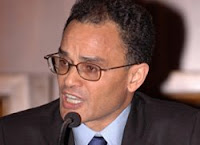
Magdi Christian Allam is under death sentence for apostasyExplaining reference to the pope's "radical voice" later in his gush, Waters tells us that the "baptism of Magdi Christian Allam is an example of Pope Benedict's radicalism" but fails to tell us why (though he does characterise it as a gesture "worth a hundred million words").

Some people become catholics, and if they are prominent enough, get to be baptised by the pope. That the pope did the honours on Allam is supremely unsurprising.

Ayaan Hirsi Ali is now permanently in hiding
Now if the pope meant the baptism as the ecclesiastical equivalent of a two-fingered salute to islamic absolutists, then bully for him, but it was hardly a particularly radical act for him to personally receive a celebrated journalist into the arms of the church (no more than was his welcome for Tony Blair to the one true religion). The act was far less radical -- not to mention less original -- than the Dutch Liberal Party were when they accepted at least equally brave (but at that time far less prominent) ex-muslim Ayaan Hirsi Ali as a parliamentary candidate. If the Dutch Liberals could be accused of opportunism (an accusation that surfaced more than once -- from christian circles, amongst others), then the same could be more easily said of the Holy See.

Incidentally, Waters crassly misrepresents Allam when he characterises him as believing that Hitchens and Dawkins are leading us blindly to "the suicide of our civilisation". What Allam was in fact referring to when he used the phrase was the awful habit of the liberal left to use an ethic of multi-cultural tolerance as an argument against expecting civilised behaviour from conservative islamic immigrants to Europe (see John Hooper article here, which quotes Allam in context). Allam apparently sees such tolerance of intolerance as extremely dangerous. Waters knows (or should know) that Allam's not the first person to say this. Indeed he's only agreeing with Hitchens and Dawkins, who have both been saying precisely this since well before 9/11.

Here's another piece of breathless nonsense (and there's literally one in nearly every sentence)

...what has emerged is what was implicit in his magisterial writings over several decades: a supreme intellect mounted in a most animated humanity, a man who in his lifetime has watched mankind lurch between great good and the greatest evil, and seeks to reconcile these observations with the truths he has inherited.
On the subject of Benedict's "supreme intellect" and his "magisterial writings" have a look a previous blog of mine, Benedict's love of truth. In this blogger's humble, the material associated with the Regensberg and La Sapienza controversies at least look more like political watchyourbackery than intellectual brilliance -- cuteness rather than acuity. He may have written more interesting stuff, but I ain't seen it yet.

The love and hope apocalypse
For Waters' analysis of where the modern world is going astray, take a look at this:

The two most pressing issues of our time [are] the haemorrhaging from public language of, respectively, love and hope.
No reason to believe this to be a burning issue is offered. He doesn't give us an explanation of what he (or the pope) even means by it. The assertion simply leaves you at a loss. Perhaps there's something poetic going on and he simply wants to paint a picture of hatred and despair in contemporary society, possibly to provide support for his notorious nostalgic streak (which got a withering mention recently in Roy Foster's 'Luck and the Irish'). Personally, I don't see either term being used less often in public than when I was a smaller and less aggressive, but even if it did, I'm not sure it would worry me more than climate change, or the newly emerging global food-supply crisis, or the appalling state of matters in the Middle East, or in Sub-Saharan Africa. The workings of Waters' mind are mysterious indeed.

This bit sounds like a more typical apocalyptic vision, more suitable to the end of the 10th Century than the start of the 21st:

[The 60's revolution] adherents, ... alarmed by the listlessness of their
children and the imminence of the darkness[!] they have themselves summoned, now cry out for reassurance to Richard Dawkins and Christopher Hitchens...
Just who's looking for reassurance here? Is he trying to convince himself that those who agree with Dawkins and Hitchens are in a way religious too, or are at least searching in vain for the religion that Waters has found? Either way, he's fails to offer us any reasons why we should think so too.

The evil media
Waters (despite the fact that his attitudes are typical of a very large part of the Irish journalistic establishment) has it in for the media.

[at the time of his elevation] Benedict was, by the secular media analysis, a stop-gap and a throwback, a "reactionary", a "right-winger", an obscurantist.
Leaving aside who exactly said all this (the majority of the Irish media, despite the misgivings of many, stayed largely, and in my opinion a bit too tamely, silent -- though they did occasionally quote catholic liberals' misgivings on the church's choice of CEO), Waters implies that these secular media were wrong. But if they did indeed have such attitudes then they were pretty clearly right in almost all respects. The pope obviously wants to turn the clock back on many of the achievements of the Enlightenment (or, in Waters' wince-inducing euphemism, to "spearhead a new Enlightenment"). What words other than 'throwback' or 'reactionary' would describe such an attitude better? And the same pope intervened publicly on many occasions in favour of the parties that cluster around Silvio Berlusconi and not once in favour of the Italian left or centre before the recent Italian general election. What expression fits better than "right-wing" for such behaviour?

As for this:

One of the many paradoxes of being pope in the modern world is that you must speak through a megaphone controlled by your enemies.
The pope runs a radio station, effectively controls hundreds of others, has thousands of publications in his pocket, tens of thousands of well-placed friends in the media willing to do all in their power to see that he looks good and is subject to a general (completely unearned) respect from the not-particularly-bothered journalistic majority by virtue of his position at the head of the single most important religious organisation in the world. How he can justify such a melodramatic description of an obviously sympathetic world media as a megaphone controlled by his "enemies" is entirely beyond me. Maybe church 'enemies' Eamonn McCann and Emer O'Kelly are able to pull some very secret and very useful strings in very influential media circles.

Funny thing is, at least in Ireland, the mainstream media is brimming over with commentators (and David Quinn, Breda O'Brien, Waters himself, Rónán Mullen, Mary Kenny and William Reville are just a few of them) who repeat ad nauseam the accusation that the established media have a deeply-felt and completely unfounded hatred of religion. Indeed it sometimes seems that this particular section of the media establishment sees it as its most important single task to inform the general public of this shocking factoid. And they all do it as if they were a frail, ragged figure, calling from the wilderness. Yet they all get to appear regularly on RTÉ.

20th century history according to Waters
Waters' take on the 60's is quite simply as wrong as you can get:

The unarmed coup of the 1960s, ... sought to install scientific rationalism as the guiding light of the age
What the 60's are justly famous for, apart from free love and the Beatles, is a revolution in thinking that was aimed precisely against scientific rationalism. The 60's were the years when the anti-rationalist ideas of post-modernism and its allies reached a tipping point that would eventually result in them becoming mainstream in university humanities departments. It seems to me that part of what Hitchens and Dawkins and Hirsi Ali and the like are attempting to do is to at least partially restore the relationship between reality and truth that seemed to be lost in the 60's. Benedict and Waters claim to want the same, but Waters at least seems mixed up about what he's arguing against -- scientific rationalism or its great opponent, 60's style relativism.

Just as an aside, Benedict and Waters should be careful what they wish for. The defeat of 1960's relativism implies the defeat of the idea that all world views are equally valid. In relativism's hypyothetical absence each world view will need to provide a justification for itself. The most obvious justification of a set of beliefs is evidence and, as Benedict surely knows, evidence is not on the side of roman catholic orthodoxy.

The newspaper of record
Whatever about that, Waters' article is unbearably shrill and full of the most slavish cliché-ridden sychophancy. It also manages to be essentially empty of content and factually inaccurate at the same time. It also contains a nasty misrepresentation of the words of one of its main subjects.

It's what's commonly known as a pious rant. That it appears in Ireland's national newspaper of record is, to put it as delicately as possible, a source of concern. Nor is his latest effort a one-off. Waters' involvement with the Italian-founded catholic charismatic movement, Communion and Liberation (announced in his just-released book and alluded to in his most recent articles) may or may not have something to do with it.

The Irish Times' reputation depends on the quality of its journalism. Articles like the one Waters wrote today (and like William Reville wrote yesterday -- check here) are a threat to the paper's status as Ireland's most serious newspaper simply because they're impossible to take seriously. Geraldine Kennedy should take care if she doesn't want to wake up one morning and realise that her paper has slowly let its reputation for quality opinion journalism ebb away. In this blogger's opinion some serious damage has already been done.