Showing posts with label religion. Show all posts

18 May 2008

Gray calling the kettle black

The following article is slight adaptation of something I put together and did the rounds with a few weeks ago (namely during Easter Week), when ace philosophical poseur, John Gray, was commissioned not one but two full-length opinion pieces in the Irish Times. It wasn't published in The Irish Times or anywhere else.

Now it may be that I can't write (please let me know if this is the case), but since no other article was later published to rebutt the poisonous tripe contained in the two Gray efforts, I feel the whole episode illustrates my previously expressed contention that people are allowed write any calumny they like in the Irish print media (and particularly in the Irish Times) without having to concede right of reply to those they insult, just as long as the lie is written for the benefit of 'belief'.


Philosophical poseur, Gray is best known for bad-mouthing the EnlightenmentThe flurry of anti-secular aggression written under the cover of Easter week in the Irish Times is illustrative of the level of absurdity that the debate on the role of religion in society has reached in Ireland. In holy week British celebrity philosopher, John Gray, had not one but two opinion articles hostile to atheism in the Irish paper of record (as usual, you may need to pay your dues to Geraldine to get these links to work). As well as his efforts, our own home-grown scourge of the secular, John Waters, put his oar in, as did Roman Catholic Orthodoxy’s defender of the faith, Breda O’Brien. And what was there in reply for the non-religious? Not a column inch outside of a single rather mild letter to the editor on Easter Saturday.

Blood libel
In his book-length rant against the Enlightenment, “Straw Dogs”, Gray rolled out the old blood libel that has become a weapon of choice for anti-secularists everywhere: i.e. that atheism was at least partially responsible for Nazism. He repeats this ridiculous accusation in the first of his IT articles. (Incidentally, this nasty piece of propaganda was since repeated without a squeak from the media by the Benedict during his visit to the US.) No argument does Gray present apart from the earth-shattering insight that the Nazis foully perverted the discoveries of Darwin to justify their extraordinary savagery.

Gray (and, shamefully, Benedict too) seems to know very little about the history of Nazism, which owed as much to pagan and Christian religious traditions as it did to atheism. Indeed National Socialism’s ideology was informed more by nostalgic anti-enlightenment romanticism than ever it was by any great enlightenment philosophers, as any study of proto-Nazi movements in 19th and early 20th Century will clarify. Indeed it seems it was mainly this Nazi yearning for a non-existent past that attracted the philosopher Heidegger to the ranks of the Hitler’s party (though ambition also surely played a role). It’s ironic now that the same Heidegger is one of the two or three world philosophers most cited by the Irish religious intelligentsia as leaving open a space for religion in a post-enlightenment world.

Schoolyard taunts
Gray’s case against memetics is even worse. Memetics is Richard Dawkins' exploration of the relatively modest and thought-provoking idea that genes may not be the only information storage systems in the world that both affect human behaviour and are capable of reproduction and variation, and are therefore also subject to their own evolutionary pressures. Cultural change, suggests Dawkins, may also be fruitfully be analysed in a similar way, where the concept of genes is replaced by what he calls "memes", which we are to interpret as ideas, opinions, beliefs and other mental artefacts that may be more or less effective in reproducing themselves via communication between human minds. Gray doesn’t even bother to argue with him. Indeed his attack is little more than a series of schoolyard taunts.

In fairness, maybe Gray is responding to Dawkins’ unfortunate metaphor for “memeplexes” (including religious memeplexes) as “viruses of the mind” (this expression has indeed led to much misunderstanding – especially when some of Dawkins’ other undiplomatic pronouncements are added to the mix). However, in neither his books nor his newspaper articles does Gray let us in on his reasoning on the merits of the theory. He limits himself to thumbing his nose at it.

Religions don't make factual claims - Gray
Gray also informs us (amid a diversionary swirl of intellectual-sounding verbiage) that religions do not make any claims about how things are in the world (apparently only “some western Christian traditions under the influence of Greek philosophy” do that), and accuses his scientific opponents of refusing to acknowledge this factoid. He doesn’t mention the oft-repeated assertion by Dawkins that any religion that avoids making such supernatural metaphysical claims is ok with him.

Self-confessed Gray fan John Waters, in his Good Friday article, accidentally illustrates the absurdity of Gray’s position, at least in an Irish context. In time-hallowed, Greek-influenced, Christian tradition, Waters makes the claim that the Resurrection of Jesus was an historical fact. (“… Jesus became, once again, as alive as we are. … This, too, is history”.) ... Well, ahem, on the contrary, a newly released book – “The Resurrection” by biblical scholar and historian Geza Vermes – eloquently argues the already obvious fact that the story in St. John’s Gospel was nothing more than a myth.

Geza Vermes, who has illustrated that the resurrection myth is just that, a myth.Whether or not Vermes is right (and he clearly is), Waters is repeating a (perhaps the) central factual claim of the most influential religion in Ireland. The assertion (to adapt some of Gray’s phraseology) is obviously a proposition struggling to be accepted as a fact. Like any other historical assertion, it must therefore stand or fall on the basis of evidence. In short, nobody has a problem with the Resurrection story as an allegory, but as an historical claim it requires evidence (and, being an extraordinary claim, it needs extraordinary evidence at that).

So, does Gray support Waters’ assertion? He should be forced to answer the question clearly. Does he support the legitimacy of such claims as that Resurrection actually occurred? If his answer is yes, then his argument falls apart immediately, as this is almost the prototypical example of a religion making claims about objective historical fact. If it is no, then Dawkins and others have no beef with him. And there simply isn’t room for a maybe. Either it happened or it didn't.

The myth of anti-religious bias
RTE and the Irish Times are often accused of having an anti-religious bias. Yet the Irish Times provides a pro-religious opinion piece every week (Rite & Reason) which rarely or never invites non-religious contributors. The paper also routinely provides regular space for predictably pro-religious commentators (such as O’Brien and Waters) and yet provides effectively no counterbalancing space for opposing views. In this context, the Holy Week articles were fairly typical of the Irish Times editorial approach. Of course and as usual, RTE provided full coverage of a variety of religious events during the week, reported uncritically on the religious pronouncements of a variety of religious and political leaders. Both organisations clearly have a de facto policy of ensuring that non-religious writers refrain from articulating views critical to people’s religious beliefs (this policy is possibly especially strongly enforced in the time leading up to Easter and Christmas, but clearly applies all year round).

Prof Geraldine Kennedy has defended the indefensible views of Kevin Myers and John Waters in the past on the basis of freedom of expression, but obviously doesn't give a hoot about fair play to Irelands irreligiousThe bias in the Irish media that religious commentators never tire of complaining of on religious matters is obvious to anyone who makes the effort of looking. However, the articles printed in Holy Week 2008 in the Irish Times neatly illustrate the point that this bias is by no means against religious world views. On the contrary, the imbalance is very much against non and anti-religious views, and is largely based on a fear of offending religious sensibilities. Sensitive as the print media are to the feelings of the religious-minded, they seem completely indifferent to the devastating effect their self-censorship has on the freedom of expression of what John Gray calls “proselytising secularists” – i.e. people critical of religion who are unwilling to be shut up.


For an excellent critique of Gray's nonsense, have a look at A.C. Grayling's article on the New Humanist Website.

13 May 2008

The bishops haven't said enough

The long-overdue admission by the Catholic Bishops' Conference yesterday that there are too many catholic schools in the country to meet demand for this model of education has been the source of much optimism. Yesterday's pastoral letter even included plans to cede control of some of their schools to "wholly or partly to lay people". It would seem petty not to praise them for making this admission and responding by announcing these plans. And indeed John Walshe of the indo is almost breathless about them.

However, we need to be very careful about what they said -- and what they didn't say, for indeed they didn't say very much about the Irish education system's present that wasn't already obvious, and they didn't say very much about their plans for Irish education's future that wasn't already inevitable.

That there is an oversupply of catholic schools has been clear at least since 2004, with the publication of the Educational Research Centre's survey, Views of the Irish public on education in 2004. Very mysteriously it didn't receive wide publicity at the time, but its raw results showed that between 49.6 and 61% of Irish people favoured a non or interdenominational approach to education in the Republic of Ireland. Just 44.7% were willing to even grant parents the right to choose denominational education for their children. See Table 20 on page 34.

In March of this year, David Quinn's IONA Institute received the result of a Red C poll they commissioned on the same subject (for more on this survey and IONA's dishonest interpretation of it, see my previous post here). The results were slightly different, as the subject is very sensitive to how questions are put on the questionnaire (I've asked for, but still haven't got, the IONA wording), but even with the IONA-commissioned survey, only 49% of parents favoured catholic denominational education. Compare this against the figure of 92% of schools in the country being catholic and denominational, a figure which understates the real position, as catholic schools tend to be larger than schools of other denominations and of none.

Another unpleasant surprise was the survey commissioned by the bishops' conference itself, which, despite a wording that could be expected to heavily bias results in favour of pro-denominational views, and despite the fact that the survey was conducted only in catholic schools, support for catholic denominational education came out even lower: 52%, given the choice, would not opt for a denominational school. The survey was made over the whole island, north and south. (A couple of other things about the survey need to be borne in mind: it was clearly marked as having been commissioned by an organ of the Catholic Church and was collected personally, both of which factors could also be expected to influence the results.)

So it's hardly rocket science that there are too many catholic schools in the country.

As for handing over schools to lay management, we're not talking about anything that hasn't already started to happen. Last year, for example, the Christian Brothers, largely due to the fact that they haven't got the personnel to do the work (there hasn't been a single new Christian Brother created in a good few years now), ceded control of many of their schools to the Edmund Rice Schools Trust, made up of "the laity". It should be noted though, that this does not necessarily mean such schools become automatically non or interdenominational (The charter of the CBS trust expressly specifies that schools under its care remain catholic, and trustees were all appointed by the order). In fact, no catholic school has yet declared itself no longer catholic and/or no longer denominational in the history of the state. The bishops' pastoral letter doesn't say anything about plans to do so either.

The Christian Brothers are not the only ones having trouble finding manpower. There is not a single organisation of the religious that's bucking the trend of generalised recruitment meltdown. Nobody wants to be a priest or a nun anymore. The immediate future of the catholic church does indeed seem therefore to be in the hands of the laity. But the laity includes, for example, most of the membership of Opus Dei, very few of whom are likely to be well disposed towards multi or non-denominationalism.

Personally, your blogger is not expecting any catholic schools to become multi-denominational overnight. It is, of course, possible that the new trusts running the schools will be eventually controlled by the parents of children attending them, which would probably over time lead to the school slowly converting to a multi or non-denominational model as new parents become involved in school management. It's not yet clear what models of trusteeship will be chosen. The catholic heirarchy is not renowned for its commitment to democracy in bodies under its tutelage.

John Walshe obviously ran with a tactical leak of the pastoral letter in his article yesterday. For some reason or other, he mentions casually a rough figure of 10-20% of schools that he suggests may be removed from direct church control. I wonder whether he picked the ballpark figure out of the air, or has a reason for quoting it. To be clear, given the results of the three surveys outlined above, the appropriate percentage of schools for removal from church control would seem to be about 50%. The maths is easy: actual percentage of schools controlled by church: at least 92%, percentage of parents requiring catholic denominational education: 45% or so (and falling).

The bishops have declared their strong support for the "primacy of parents' rights in the education of their children." It seems possible that their pastoral letter is a sign that they take their position on the issue seriously. I hope so.

But after looking at the numbers and at what the Bishops say and fail to say, what emerges could still be interpreted by an aggressive secularist like me as a damage limitation exercise. I hope I'm wrong.

The bishops have indicated that their letter should be interpreted as an invitation to dialogue. They are not clear, however, on who they want to participate in this dialogue. I hope aggressive secularists are invited.

25 April 2008

Waters' watery nonsense

John Waters' current output is a threat to The Irish Times reputationAwed admiration
Sometimes you just have to let the jaw drop in awed admiration at the ability of a very large proportion of the opinion writers in the Irish papers to unblushingly say the most obvious nonsense imaginable.

The moment I saw the first sentence of John Waters' piece in today's Irish Times was one such occasion. When I saw the second sentence was another, and so on for the whole length of the article.

The overall effect is that of a slavish premature obituary for the present pope, with a touch of Book of Revelation, a dash of paranoid fantasy about media conspiracies against religion and topped off with a good old-fashioned whopper of an embarrassing factual error.

The temptation is to take the whole thing apart line by line, but I have neither the time nor the energy to do that, and you probably have neither the time nor the inclination to read the result. Allow me, however, to give you a few of the lowlights of his effort.

Breathless praise for the pope
For hagiographical nonsense, check this out:
If we care to contemplate the irrelevance of chronological age, let us consider that last week marked the 81st birthday of the most radical voice in modern Europe. Benedict XVI, now three years into his papacy, has already confounded his enemies and delighted his admirers in a pontificate that glitters beyond all expectations.
"...the most radical voice in modern Europe"? What is he talking about? This pope has done practically nothing at all in updating the doctrine of the roman catholic church since his elevation to the Holy See (with the possible exception of allowing the publication by a catholic body of a document that made the very unradical claim that limbo, after all, doesn't exist). His encyclicals have been all on subjects carefully selected as uncontroversial and his public statements have been if anything more circumspect than they were in his time as god's Rotweiler.

As for a pontificate that "glitters beyond expectations"? Where does that come from? Even Eoghan Harris wouldn't talk in such terms about Bertie's time as Taoiseach. Perhaps what Waters means is that his first three years on the throne of Peter hasn't been quite the disaster some of the church's pessimists predicted it would be. But his performance wouldn't need to be glittering to have exceeded some of those expectations.

Magdi Christian Allam is under death sentence for apostasyExplaining reference to the pope's "radical voice" later in his gush, Waters tells us that the "baptism of Magdi Christian Allam is an example of Pope Benedict's radicalism" but fails to tell us why (though he does characterise it as a gesture "worth a hundred million words").

Some people become catholics, and if they are prominent enough, get to be baptised by the pope. That the pope did the honours on Allam is supremely unsurprising.
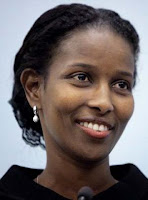
Ayaan Hirsi Ali is now permanently in hiding
Now if the pope meant the baptism as the ecclesiastical equivalent of a two-fingered salute to islamic absolutists, then bully for him, but it was hardly a particularly radical act for him to personally receive a celebrated journalist into the arms of the church (no more than was his welcome for Tony Blair to the one true religion). The act was far less radical -- not to mention less original -- than the Dutch Liberal Party were when they accepted at least equally brave (but at that time far less prominent) ex-muslim Ayaan Hirsi Ali as a parliamentary candidate. If the Dutch Liberals could be accused of opportunism (an accusation that surfaced more than once -- from christian circles, amongst others), then the same could be more easily said of the Holy See.

Incidentally, Waters crassly misrepresents Allam when he characterises him as believing that Hitchens and Dawkins are leading us blindly to "the suicide of our civilisation". What Allam was in fact referring to when he used the phrase was the awful habit of the liberal left to use an ethic of multi-cultural tolerance as an argument against expecting civilised behaviour from conservative islamic immigrants to Europe (see John Hooper article here, which quotes Allam in context). Allam apparently sees such tolerance of intolerance as extremely dangerous. Waters knows (or should know) that Allam's not the first person to say this. Indeed he's only agreeing with Hitchens and Dawkins, who have both been saying precisely this since well before 9/11.

Here's another piece of breathless nonsense (and there's literally one in nearly every sentence)

...what has emerged is what was implicit in his magisterial writings over several decades: a supreme intellect mounted in a most animated humanity, a man who in his lifetime has watched mankind lurch between great good and the greatest evil, and seeks to reconcile these observations with the truths he has inherited.
On the subject of Benedict's "supreme intellect" and his "magisterial writings" have a look a previous blog of mine, Benedict's love of truth. In this blogger's humble, the material associated with the Regensberg and La Sapienza controversies at least look more like political watchyourbackery than intellectual brilliance -- cuteness rather than acuity. He may have written more interesting stuff, but I ain't seen it yet.

The love and hope apocalypse
For Waters' analysis of where the modern world is going astray, take a look at this:

The two most pressing issues of our time [are] the haemorrhaging from public language of, respectively, love and hope.
No reason to believe this to be a burning issue is offered. He doesn't give us an explanation of what he (or the pope) even means by it. The assertion simply leaves you at a loss. Perhaps there's something poetic going on and he simply wants to paint a picture of hatred and despair in contemporary society, possibly to provide support for his notorious nostalgic streak (which got a withering mention recently in Roy Foster's 'Luck and the Irish'). Personally, I don't see either term being used less often in public than when I was a smaller and less aggressive, but even if it did, I'm not sure it would worry me more than climate change, or the newly emerging global food-supply crisis, or the appalling state of matters in the Middle East, or in Sub-Saharan Africa. The workings of Waters' mind are mysterious indeed.

This bit sounds like a more typical apocalyptic vision, more suitable to the end of the 10th Century than the start of the 21st:

[The 60's revolution] adherents, ... alarmed by the listlessness of their
children and the imminence of the darkness[!] they have themselves summoned, now cry out for reassurance to Richard Dawkins and Christopher Hitchens...
Just who's looking for reassurance here? Is he trying to convince himself that those who agree with Dawkins and Hitchens are in a way religious too, or are at least searching in vain for the religion that Waters has found? Either way, he's fails to offer us any reasons why we should think so too.

The evil media
Waters (despite the fact that his attitudes are typical of a very large part of the Irish journalistic establishment) has it in for the media.

[at the time of his elevation] Benedict was, by the secular media analysis, a stop-gap and a throwback, a "reactionary", a "right-winger", an obscurantist.
Leaving aside who exactly said all this (the majority of the Irish media, despite the misgivings of many, stayed largely, and in my opinion a bit too tamely, silent -- though they did occasionally quote catholic liberals' misgivings on the church's choice of CEO), Waters implies that these secular media were wrong. But if they did indeed have such attitudes then they were pretty clearly right in almost all respects. The pope obviously wants to turn the clock back on many of the achievements of the Enlightenment (or, in Waters' wince-inducing euphemism, to "spearhead a new Enlightenment"). What words other than 'throwback' or 'reactionary' would describe such an attitude better? And the same pope intervened publicly on many occasions in favour of the parties that cluster around Silvio Berlusconi and not once in favour of the Italian left or centre before the recent Italian general election. What expression fits better than "right-wing" for such behaviour?

As for this:

One of the many paradoxes of being pope in the modern world is that you must speak through a megaphone controlled by your enemies.
The pope runs a radio station, effectively controls hundreds of others, has thousands of publications in his pocket, tens of thousands of well-placed friends in the media willing to do all in their power to see that he looks good and is subject to a general (completely unearned) respect from the not-particularly-bothered journalistic majority by virtue of his position at the head of the single most important religious organisation in the world. How he can justify such a melodramatic description of an obviously sympathetic world media as a megaphone controlled by his "enemies" is entirely beyond me. Maybe church 'enemies' Eamonn McCann and Emer O'Kelly are able to pull some very secret and very useful strings in very influential media circles.

Funny thing is, at least in Ireland, the mainstream media is brimming over with commentators (and David Quinn, Breda O'Brien, Waters himself, Rónán Mullen, Mary Kenny and William Reville are just a few of them) who repeat ad nauseam the accusation that the established media have a deeply-felt and completely unfounded hatred of religion. Indeed it sometimes seems that this particular section of the media establishment sees it as its most important single task to inform the general public of this shocking factoid. And they all do it as if they were a frail, ragged figure, calling from the wilderness. Yet they all get to appear regularly on RTÉ.

20th century history according to Waters
Waters' take on the 60's is quite simply as wrong as you can get:

The unarmed coup of the 1960s, ... sought to install scientific rationalism as the guiding light of the age
What the 60's are justly famous for, apart from free love and the Beatles, is a revolution in thinking that was aimed precisely against scientific rationalism. The 60's were the years when the anti-rationalist ideas of post-modernism and its allies reached a tipping point that would eventually result in them becoming mainstream in university humanities departments. It seems to me that part of what Hitchens and Dawkins and Hirsi Ali and the like are attempting to do is to at least partially restore the relationship between reality and truth that seemed to be lost in the 60's. Benedict and Waters claim to want the same, but Waters at least seems mixed up about what he's arguing against -- scientific rationalism or its great opponent, 60's style relativism.

Just as an aside, Benedict and Waters should be careful what they wish for. The defeat of 1960's relativism implies the defeat of the idea that all world views are equally valid. In relativism's hypyothetical absence each world view will need to provide a justification for itself. The most obvious justification of a set of beliefs is evidence and, as Benedict surely knows, evidence is not on the side of roman catholic orthodoxy.

The newspaper of record
Whatever about that, Waters' article is unbearably shrill and full of the most slavish cliché-ridden sychophancy. It also manages to be essentially empty of content and factually inaccurate at the same time. It also contains a nasty misrepresentation of the words of one of its main subjects.

It's what's commonly known as a pious rant. That it appears in Ireland's national newspaper of record is, to put it as delicately as possible, a source of concern. Nor is his latest effort a one-off. Waters' involvement with the Italian-founded catholic charismatic movement, Communion and Liberation (announced in his just-released book and alluded to in his most recent articles) may or may not have something to do with it.

The Irish Times' reputation depends on the quality of its journalism. Articles like the one Waters wrote today (and like William Reville wrote yesterday -- check here) are a threat to the paper's status as Ireland's most serious newspaper simply because they're impossible to take seriously. Geraldine Kennedy should take care if she doesn't want to wake up one morning and realise that her paper has slowly let its reputation for quality opinion journalism ebb away. In this blogger's opinion some serious damage has already been done.

24 April 2008

Reville's theology is back at the Irish Times

I'm reeling. I thought that after the drubbing Prof William Reville got the last time he started introducing theology to the science page in the Irish Times he'd made a firm resolve to limit himself in future to harmlessly cutting and pasting internet articles on the nutritional benefits of bananas and non-benefits of multi-vitamin supplements.

But alas, I'm sad to announce that, as of today, Thursday 24 April 2008, the good professor has once more fallen off the wagon. The occasion of his downfall this time was the temptation to argue for protecting "the embryo back to the point of conception". Like any good addict, he makes excuses for this all-consuming need of his to engage in theological musings in inappropriate places. His own version of 'I only do it on health grounds' is that he has "biological reasons" for doing so. It doesn't take much, however, to see this as the rationalisation typical of the addicted mind that it assuredly is.

Have a look at the article (as always, on condition you pay for your IT on the web -- if not, try look over someone's shoulder on the bus, or in extremis buy a copy).

For the benefit of those who drove, cycled or walked to work, what Reville can't resist saying to us today hangs on the following thread:

...it seems to me to be wrong to arbitrarily pick any point on this continuum [of life between conception and old age] and claim that it marks the boundary between the preceding "not fully human and not deserving of protection" section and the succeeding "human enough to deserve protection" section.


The point at which human life begins, we are to understand, can only be picked at the very start of the continuum, i.e. conception. Anything else is arbitrary.

So far, so very familiar. The trouble is anyone with a bit of knowledge of the philosophical, ethical and scientific issues surrounding protection of embryos knows that it's nonsense. For a start, conception isn't a single point on a continuum -- for an egg to be fertilised is a process that takes some time.

But when should the moment of conception be defined according to the theologians? The moment when a sperm breaks into the egg (which is what most of us imagine as conception)? W ell no, that can't be it, as quite often more than one sperm manages to enter the egg cell and, through some not fully understood process, one set of chromosomes is later expelled and the other is fused into the egg's DNA over a period of half an hour or so. This fusion process itself is prone to disturbance too. So should the sublime moment be defined at exactly the time the fusion process starts or when it's complete?

While the above looks like nonsensical how-many-angels question, the point of introducing it here is to make clear that the moment at which conception is deemed to have happened is also to some extent arbitrary. For a conception-obsessed theological ethicist, the question might even be of practical relevance to the work of scientists who have reason to fiddle around with sperm and eggs at various stages of mingling. For the rest of us though, the question is nonsense. Incidentally, for most biologists, the term 'conception' is so irredeemably confusing, it is not used at all. The preferred term for the process of combination of male and female DNA in an egg is 'fertilisation'.

What is important is the observation that the moment of conception is an absurdly early point for defining the beginning of human life.

For example, my beloved (who, incidentally, is the mother of my equally beloved child) happens to share a single moment of conception with her identical twin sister (indeed the only reason I can tell them apart visually is the fortunate fact that my partner sat on her sister's ear for the whole of late pregnancy, thus giving the latter a slightly longer, narrower head). Just ask the question as to when the life of each of them began and you begin to feel the pull of the whirlwind of uncertainty (and absurdity) surrounding the standard 'at conception' view.

Besides this, it is technically possible (or will probably be soon) to create people without giving them a moment of conception. Let's consider the example of scientists (with half an eye on squaring the theological problems surrounding experimentation on zygotes) who take animal eggs, evacuate their nuclei, and replace the missing DNA with a sample from say, a skin cell from the nearest lab technician. Part of the reason for doing this would to be to deal with a shortage of fertilised human egg cells, but researchers looking at this option have half an eye on squaring the theological problems surrounding experimentation on zygotes in their efforts to check out the potential of embryonic stem cells.

After all, an animal egg cell (fertilised or not) is held by no theology to be a sacred human life, and neither is any component scraping of Lee Chang's or Siobhan Murphy (PhD)'s edidermis. But the point of the exercise is to produce something that is as near as possible identical to a fertilised ovum, to let it grow a little, and then to harvest stem cells from it. There is nothing in principle (apart from ethical principle) that would stop the ovum from being implanted and growing into a person with an uncanny resemblence to Lee or Dr. Siobhan. But this person would never have been conceived. Conception was therefore clearly not when life for this hypothetical person began. I should emphasise that there is no question of any of this actually happening amongst reputable scientists, I'm just making a point about the logic of the conception argument.

The professor's official photo from the UCC websiteIndeed, the adult stem cells that Reville (very optimistically) claims to be an alternative to embryo stem cells are not all that different. With a bit of tinkering (which may indeed be necessary to make them useful for some sorts of stem cell research) they could become as much potential human beings as much as any ovum with the full complement of human DNA. After all, it is the very flexibility of stem cells that both makes them so interesting therapeutically and so full of potential to grow into any type of human tissue (even the full set in the correct sequence -- i.e. an adult human).

Besides, it's been known for some time that more than half (some say a lot more than half) of ova fertilised by the standard route (you know what I mean) are expelled from the potential mother's body without ever implanting. If Reville's argument based on no arbitrary lines being ethically justifiable were to be taken seriously, then medical science would have as great a responsibility to save these human individuals from death as they would an eight-year-old suffering from leukemia. After all, by an argument practically identical to Reville's, it would seem tobe wrong to arbitrarily pick any point on the continuum of life between conception and old age and claim that it marks the boundary between the preceding "let nature take its course" section and the succeeding "human enough to deserve the full protection of the best that medical science can do".

Reville should know all these arguments (and the fact that he mentions twins in his article could be interpreted to suggest that he's at least subconsciously aware of one or two of them).

In a typical bit of sophism (typical of roman catholic apologists, that is) Reville tells us:

... the biological fact is that the early embryo is "a human at his/her stage of a microscopic ball of cells". [the inexplicable quotes are his]


Biology does nothing of the sort. What it might do in this regard is tell us what we already know, i.e. that an embryo is certainly human in the same sense as Dr. Siobhan's skin cells are, but has no position on its status as a human individual. That's a job for philosophy (which Reville is evidently unqualified in).

One would have thought that a scientist of the eminence of Prof. Reville would be above mixing the noun clase "a human" with the simple (and very different adjective "human".

Unfortunately for Reville's desire for a clear point at which humans beings become human beings, such a point doesn't exist.

My own view (for what it's worth) is the following: A fertilised egg is much more than just equivalent to a skin scraping, and should therefore never be treated in a cavalier fashion. An early embryo is obviously deserving of even more respect. As the embryo develops it will accumulate features that increase its status as a being, until it reaches a stage where this status is effectively equivalent to a fully recognised human being. If an arbitrary line need be drawn (and for judicial and other reasons it may be necessary) then it should be drawn early. But, for reasons already outlined, not as absurdly early as conception.

Reville's reach for the theological bottle was by his own account occasioned by the RTE's broadcast on stem-cell research as part of the "Science Friction" series, which Reville informs us was unbalanced. Since the full program isn't available on the RTÉ site I can't make a judgement on its objectivity, but the pots and kettles principle would seem to apply to Reville in this respect. As editor of the Irish newspaper for record's weekly science section, should he not also have a duty to provide balance? Yet, not for the first time, Reville's article is severely unbalanced. It is also either surprisingly uninformed, or intentionally suppresses much relevant information available from biology ... which, as public awareness of science officer at UCC he surely has an obligation to keep us informed.


Woman priests
Also in the Irish Times today is a letter that magnificently illustrates that any unlikely change of policy of the Vatican on the question of woman priests would not necessarily lead to an improved attitude amongst the clergy to 'the laity' (or vice versa). Elisabeth Roddy wants woman priests, amongst other things, to "galvanise those members of the laity who think it is enough to sit like suet puddings, waiting for the clergy to pour spiritual custard over them".

I wonder which members of the laity she means. Perhaps those who, having profited from long experience, would run a mile at even a sniff of spiritual custard. Or perhaps she means those that couldn't be bothered about the catholic church, even to the extent of making it clear that they are no longer part of it. There's a lot of that about.

22 April 2008

Aggressive secularism in the salons of Dublin

(This was submitted to Village for publication on 11 August, 2007. It wasn't published.)

Ireland is still religious
It's funny how those conservative religious commentators are capable of pointing out the obvious and dressing it up as if it were some sort of revelation. So it was this week with David Quinn, who's back writing for the Irish Independent after a short break in other pastures.

Quinn reveals to us the information that something like 40% of Irish people still go to church of a Sunday and that therefore religion is still strong in Ireland. This pretty unsurprising message is in itself a harmless enough reminder of the fact of continuing religious belief in Ireland, and while one could argue with Quinn's assumption that this a good thing, he's unlikely to find anyone disagreeing with him on the statistics. Disconcertingly, this is precisely where he decides to pick a fight.

The "many commentators" fiction
He informs us that "many commentators" do not recognise the continued religious convictions of a much larger number of Irish people than, say, in Sweden or the former East Germany but fails to specify exactly which commentators he's talking about. Now yours truly hasn't been living in Ireland for a while, but for my sins I do try to keep up with what the Irish media have to say about religion, and have never ever come upon any commentator anywhere who thinks that Ireland has become anything like central or northern Europe in terms of levels of religious belief and practice. In fact I'd be surprised if anyone in the Irish media has ever said anything of the sort.

Now this indiscriminate use of the term "many commentators" is a central part of the armoury of Quinn and his allies. "Many [establishment] commentators" in the Irish media also have an destructive anti-religious bias, it seems. But if Quinn et al were forced to put together a list of names for this sinister group of opinion writers they'd come up with very few names: For my own part, the only two genuinely anti-religious opinion writers I can think of off-hand are Indo commentator, Ian O'Doherty and his courageous stable-mate, Emer O'Kelly (whose opinion pieces, incidentally, seem to be appearing far less frequently lately). Apart from them, there only a few mad bloggers and letter writers like myself (indeed, come to think of it, there's not too many of us either).

What Quinn and his pals are trying to do (with relative success unfortunately) is to equate criticism of the Catholic Church, whether or not it's accompanied by a benign disinterest in the "spiritual", with a general hostility to religion. In painting this picture, of course, the interests they are trying to serve are not those of religion in general, but the more sectional interests of the Catholic Church.

The real targets
Quinn's unnamed targets, i.e. Mary Raftery, Patsy McGarry, Fintan O'Toole, Vincent Browne and the rest of the notorious 'Irish Times establishment' are emphatically not anti-religious in their work. In fact, while they have all been witheringly critical of the Catholic Church in the past few years, they have all expressed admiration for religious attitudes and practices, and many of them participate in religiously-inspired initiatives and support religious charities by word and deed. Even Browne, who made his non-religious views clear in his recently-axed radio programs, could never be described as opposed to the spiritual side of life. Indeed he has always discussed religion with what I would call an exaggerated respect (though sometimes with understandable incredulity). Anyway, for all the accusations of anti-religious bias thrown at RTE explicitly, Browne was outnumbered there dozens to one by the Marian Finnucanes and Joe Duffys of this world.

As for the left-wing politicians that they accuse (again without giving names) of attacking religious views, such politicians simply don't exist. There is certainly no-one in Irish politics willing to criticise religious belief openly. Even emphatically non-left-winger Liz O'Donnell was careful to limit her notorious 2005 criticism of the Catholic Church to matters of abuse of power and excessive influence, and made no comment on the theology or philosophy of anyone (except perhaps on the any-way-the-wind-blows philosophy of the Taoiseach). And yet O'Donnell's statement was greeted with almost universal disapproval, and was described as everything from 'intemperate' to 'opportunistic'. The latter adjective has proved pretty ironic in the light of the last general election. (Incidentally, one RTE reporter even got away with saying that Bertie's response to O'Donnell was an attempt to "restore balance to the debate", notwithstanding any obligations to provide balance and fairness in broadcasting.)

Bias
In short, there is no anti-religious bias in the media. None at all. Quite the opposite. It's almost impossible to get non-religious views on the subject of religion published in the mainstream media, whether in print or on the airwaves (just check the Irish media for positive reviews any of the recent blockbuster books attacking religion). By way of contrast, it is almost laughably easy for hagiographies of obscure 19th century missionaries to be published (see the Irish Times, 7 August) and to report "verified" miracles as fact (see both Indo and Times coverage of the the canonisation of Charles of Mount Argus in late 2006, for example), while it is seemingly quite acceptable to clog up the science section of a national newspaper for weeks on end with slavish repetitions of roman catholic theology on the relationship between religion and biology (as Prof. William Reville astoundingly did last year in the Times, of all papers).

Writing disapprovingly of religion is as unacceptable in Ireland as writing scathingly about the behaviour of the Catholic Church is unavoidable. Real anti-religious writing rarely gets further than the letters pages. For the vast majority of journalists, to write hostilely about religion per se is quite simply a one-way ticket to a career outside journalism.

A fashion?
Which brings me to one of the other major weapons commonly used by the religious right: the claim that anti-religion is 'fashionable' in modern Ireland. In a previous blog I discussed John Cooney (a predecessor of Quinn's as religious correspondent for the Indo, and incidentally no ultraconservative) using this argument, but it's also been wheeled out regularly by Quinn and by his co-religionary Breda O'Brien (also in Irish Times!), as well as the newly elevated Senator Rónán Mullen (in his truly incredible -- though thankfully now defunct -- articles in the Examiner), amongst many others. They all somehow feel justified in arguing that it's somehow a clever career move to jump on some imagined anti-religious bandwagon (a bandwagon which a moment's thought will tell you doesn't exist).

This is an argument that I'm afraid I take personally.

Neither profitable nor popular
I hope I'm a modest enough person, but I have the idea that I can occasionally write sense (though with varying degrees of elegance). I've been writing as a non-religious person on religion to and, just occasionally, in the print media on and off for the past 20 years, and I can vouch for the fact that a clever career move it is not now nor ever was. While some of my writing has been published, and occasionally praised, I have never made a penny for any of it. However, this hobby of mine (and I wish it was more than that) has on more than one occasion got in the way of me making a few bob even in completely unrelated jobs, has caused a fair degree of strife in my family, led to me being lampooned in letters pages and caused unwelcome and unfair comment to be made about me to my loved ones behind my back.

Now I'm not looking for a new form of victim status - my main point in mentioning all this is to make clear (to adapt a Mylesian cliché) that it is neither profitable nor popular to be anti-religious in Irish journalism.

The salons
It may well be that, in certain circles despised by Quinn and his friends (it should be said that the collective status of these circles as the Irish cultural establishment is at the very best controversial), disapproval of much of the behaviour of the universal church is -- well -- universal; and it may even be that within such circles religious belief might even be under-represented in comparison to the general Irish population. But in my relatively limited experience these circles' most usual response to religion is at the very worst a sort of patronising tolerance. This goes nowhere near being hostile either to religion in general or to the religious convictions of any individual or community.

Discussion of the merits or demerits of religious faith is quite the opposite of fashionable. Most people in these circles and others are simply not interested in the subject. Now, to be uninterested in someone's pet subject (in this instance a pet subject that it seems Quinn and I are unfortunate enough to share) may give rise on occasion to resentment, but is not the same thing as being hostile to that person's opinions (whether they think like Quinn or like me). Nor is dishing out well-deserved criticism of the actions and attitudes of any religious organisation anything like attacking the religious views either of members of that organisation or of any other believers.

Still and all, there are a lot people (including Quinn) in the Irish media doing relatively well out of writing on the subject of religion. What all successful journalists specialising in religion seem to have in common is that they are generally in favour of it. For journalists outside this specialisation benign indifference is the rule. For religious journalists to say that those digging away in the opposite trenches are doing it out to be in with some imagined in crowd is either a self-serving fantasy or a paranoid illusion. There simply are no trenches opposite. And those few that do take potshots from whatever cover they can find are not the toast of the Dublin establishment. From personal experience, I can report that such guerrilla activity is relatively lonely and unprofitable.

19 April 2008

Cooney and “God bashing”

(recycled from the now defunct blog section in the Village magazine website -- first published on 18 July 2007)

Knowing what John Cooney has achieved in the past writing against ultra-conservatism in Irish religion, it’s a little sad how dismissive he was of Christopher Hitchens on 30 June in his review of his book “God is not Great” in the Irish Independent.

Also disturbing is his characterisation of the current run of books by atheists on the subject of religion as “trendy” and a “fad”. This attitude betrays a lack of generosity of the sort that liberal Christians like him claim a special access to, but it also betrays a lack of historical perspective and a wilful inattention to contemporary world politics.

For one thing, the fact is that such “fashionable” arguments about religion were quite impossible to have right up until the very recent past, at least in Ireland. Cooney forgets this despite his own participation in breaking the taboo against criticism of the institutional church in Ireland (not least via his devastating biography of John Charles McQuaid).

So it’s an irony and a pity that he is so dismissive of Hitchens’ views as those of a “secularist ranter”. He’s actually using the same sort of language in his argumentum ad hominem that was thrown at Church critics (including him) in the past. The taboo against criticism of religion no longer precludes pointing out abuses by Church institutions, but what seems at least shakily still in force is the ban on pointing out holes in the philosophies and theologies underlying religious belief. As usual in Ireland, it is foreigners like Hitchens and his allies that are (albeit only incidentally) beginning to break this taboo. Long may they prosper, say I.

Besides, this “fad” for anti-religious argumentation is anything but confined to Ireland; it is a worldwide phenomenon that has popped up independently is several places. Two recent events that have nothing at all to do with the vagaries of fashion – the 9/11 bombing and the rise of creationism (aka intelligent design) – are far more likely explanations for such arguments. There is a very close relationship between religion and said events, to such an extent that it would be surprising if a fair amount of political opposition to religion (described by Cooney as “God bashing”) would not have emerged in their wake. That God has a prima facie case to answer in both areas is obvious. Cooney’s dismissal of Hitchens’ book as a fashion accessory for this year’s summer on the beach, apart from being irrelevant, is therefore unfair, shortsighted and maybe even a little disingenuous.

An even greater pity about Cooney’s review is that he largely misses the opportunity to present his case against Hitchens’ atheism. As I mentioned on a previous blog, Hitchens’ own book possibly loses points for not really addressing the sort of moderate religion that Cooney would presumably defend, but Cooney fails to gain the same points because he effectively fails to argue at all, limiting himself to doling out a fair amount of relatively harmless bile and … well, not much else of substance.

Where is his case against Hitchens and in favour of God? Surely not in his petulant expression of distaste for Hitchens’ arguments (including a cringe-inducing comment that Hitchens’ attack on the Crusades and the Inquisition constitutes a “sneer”. Nor does he seem to make any defence contra Hitchens for the existence of God other than a rather strange argument from authority: that the great Hans Küng once countersigned Cooney’s copy of his book “Is there a God? An Answer for Today” with the word “Yes”.

Obviously, Cooney can’t accept Hitchens’ nasty God of the Bible as the God he worships, and indeed his fairly innocuous denial of this God indeed takes up a fair bit of his review. But the trouble is that Cooney doesn’t even give us a hint what sort of supreme being he does in fact believe in, except maybe the hint that it might be something along the lines of Küng’s vision of God. But, if you take the trouble to do a bit research, I think you’ll find Küng’s own vision turns out to be pretty foggy too. And when you finally manage to shine a light through the mist on the sort of being Küng has in mind when arguing for his/her/its existence, you’ll end up with rather less in your hand than Küng’s sonorous prose seems to promise. (At least in the English translation it’s pretty sonorous – check out the atmo conjured by this pretty typical example: “[belief in God] has a basis in the experience of uncertain reality itself, which raises the first and last questions of the condition of its possibility”.)

In the book Küng signed for Cooney, he talks of a “trustful” relationship with reality as being essential to leading an ethical life. Whatever he means by this, he admits (with enormous generosity) that some atheists could have such trust, and are thus capable of leading moral lives. What God is, according to the great theologian, is the justification for this trust – so to speak the practical backup that provides grounds for our ethical behaviour. And, em … when you’ve finished clearing away the undergrowth, that’s it. Atheism leads ineludibly to nihilism because, though atheists can indeed behave ethically, their “trusting” relationship with reality (upon which their ethical attitudes are based) is unfounded, and they are therefore ever prone to having the rug pulled out from under them. This “trusting” relationship must therefore have a foundation. And that foundation is what Küng calls God.

Küng seems basically in agreement with many a Nietzschean post-modernist that for morality (or ethics) to have a secure foundation, there must be a God – and that without a God, ethics (or morality) will therefore sooner or later end up going out the window. Where he differs with Nietzsche, is that he doesn’t think God has actually expired yet. The trouble is that his reasons for this belief require him to redefine God as simply the underlying reason that people believe it’s both necessary and desirable to behave ethically – stripping him (her/it) of all traditional attributes. The white beard, the disposition to sadism with Job and Abraham and the maleness (of course) are all gone, along with any personality traits whatsoever.

Now if all of this seems to you to be so much eyewash, then join me in the clubhouse. If I were to ask what causes the rain and were told that it was God what done it, and then asked what this thing called God was, only to be told that God was what caused the rain, I’d probably feel a bit short-changed (at least I would if I weren’t overawed by the reverberating tone in which the questions were answered).

And so it is here. Whatever it is that explains and justifies ethical values is God, and this God turns out to be defined as whatever it is that justifies ethical values. The thing that’s eating all the red rocks turns out to be the red rock eater, so to speak. Explanatory power, nil.

Where it gets even more confusing is that Küng admits that his case is very much dependent on there being no other way of explaining or justifying ethical behaviour other than God. As we’ve seen, Küng makes it clear that his intention is to save us from nihilism (for him, and for much of post-modern thought, the eventual consequence of atheism). But there are a number of explanations of ethical behaviour that have recently come out of the (mainly biological and anthropological) sciences and scientifically inclined philosophy, and none of them look much like what anyone would be inclined to call God. They are all, of course, the subject of much debate, and there is not yet any clear consensus on where and how the debate is going, but to argue with Küng that such natural, rather than supernatural, explanations are either a priori impossible or irrelevant is both ill-informed and unargued.

It is fairly unsurprising that Cooney doesn’t even try to give a summary of Küng’s God argument, limiting himself, as I say, to an appeal to Küng’s authority as a famous theologian of the right sort (i.e. those progressive types who tend to get into trouble with the conservative Christian establishment). Potting up Küng’s thinking into words likely to get past the editor of the Independent would seem to run the risk of exposing his argument for what it surely is: an old-fashioned empty tautology.

Incidentally, Cooney’s reluctance to actually put his case is a common tactic amongst defenders of religion in Ireland: For example, Brendan Purcell, Marian Finucane’s philosopher if not in residence then just across the road, does a fairly similar trick more or less every time he gets on the radio: when faced with an argument against religion he doesn’t wish to handle, he makes some vague mention of Heidegger’s “discoveries” about “being”, and/or throws in the non-question, “why is there something rather than nothing”. This invariably happens at the end of the program, so that no one gets the chance to ask what it actually was that Heidegger found out about being, or what it would mean to answer his non-question. One suspects that the answer in both cases is “not much”.

Well-dressed nonsense though all this may be, Küng’s (and presumably Cooney’s) vision of God as the only possible foundation of ethics, which goes back at least to Nietzsche for its origin, is very much still around amongst other thinkers. Richard Dawkins’ late opponent, the palaeontologist Stephen Jay Gould (in “Rocks of Ages” – not, by the way, his best book) talked of religion as a “magisterium” or “domain of competence” dealing with human ethical values parallel to the separate magisterium of science, with which it did not overlap. Philosopher Mary Midgley, a Dawkins opponent who’s very much still with us, sees religion in a similar way, as a sector concerned with values as opposed to facts, though she thinks the two magisteria certainly do overlap, the world of science being much affected by the world of ethics and vice versa.

Now it’s hard to argue with the separateness of the magisteria of science on the one hand and of ethics on the other, and the extent to which the two disciplines might or might not have a legitimate influence on each other is an extremely interesting subject, but what seems to walk on air is the assumption both Gould and Midgley make, but neither of them seem to think it necessary to argue for: ie, that the subject of religion and the magisterium of ethics belong in the same pigeonhole. In his own way, and with rather more sleight of hand, Küng is essentially doing the same thing. His argument for the existence of God is not too far from simply taking the term “ethics” and telling us (if “telling us” is the right expression, given all the theological obfustication surrounding his argument) that it is essentially synonymous with the word “God”.

It is hard not to believe that there is politics somewhere behind this tendency to conflate religion with ethics. The reason that people like Midgley and Gould don’t mind conflating the two terms is presumably that neither of them sees anything particularly wrong with organised religion becoming the main centres around which discipline of ethics is discussed. People like Dawkins and Hitchens (and, for what it’s worth, me) have objections to the English language being treated in such a cavalier way as to redefine the word “God” so that it means roughly “what the good guys do”. However, the main reason for opposing this unlikely conflation would be on the ground that the contemporary institutions of religion probably couldn’t be a worse set of bodies to entrust with decisions on what the rest of us should consider right and wrong. Perhaps the recently deceased pragmatist philosopher Richard Rorty had a point when he described his opposition to religion as being based more what he saw as a well-founded “anti-clericalism” than a disbelief in any argument about God (whatever that turns out to be).

While most atheists will readily acknowledge that there are excellent people practicing all sorts of religions whose views on ethics are as worthy of consideration as anyone else’s, the idea that religion should have any sort of special role in this area is pretty frightening to some of us at least (though it didn’t seem to bother Gould, despite his agnosticism).

Even John Cooney will admit that there are good reasons for our objections. Our “sneering” at the Crusades and the Inquisition are only side issues, as are our objections to the behaviour of the Biblical God towards Job, Lot’s wife and the rest of them (up to and including his own son). Much more important, for example, is the much more recent behaviour of the Catholic Church in relation to child abuse or contraception, the extraordinary moral impotence, turpitude and illiteracy displayed by Islamic “scholars” in the face of Muslim extremism, the ignorance and grotesque intellectual dishonesty of mainstream American Christianity in response to the science of evolution, as well as the slightly less shocking absurdities of the Anglican Church while discussing the participation of women and/or gay people in their priesthood.

This not to say that everyone involved in religion is a fool or a potential tyrant, but it does suggest that modern religious organisations are anything but competent in guiding humanity on the difference between right and wrong.

Cooney and Küng are both welcome to use whatever vocabulary they are most comfortable with, but if they do insist, for example, on using the classical term “God” with the unorthodox sense roughly outlined above, it would be useful if they could make a little clearer that their meaning is nowhere near the standard usage.

Of course, the suspicion is that they will never give this clarity, for the very good reason that they mess around with these terms precisely to create unclarity – to erect a smokescreen to disguise from their alleged co-religionaries, from us and perhaps even from themselves that their views on religion are basically incompatible with the beliefs demanded by the institutional church they are both still obviously at least emotionally attached to, as well as contradictory to beliefs that they had set out in the first place to reassure themselves of.

While we are going about breaking religious taboos in the Irish media, one we could add to our to-do list is the one that prevents eminent progressive theologians from being subjected to any sort of criticism in print. This is not just an Irish taboo. Even Dawkins and Hitchens have so far respected it, by not engaging direct attacks on anything but the most old-fashioned, non-right-on and most obvious theological nonsense. The taboo is reinforced by the difficulty in talking about the subject intelligibly in the media (a task not helped by sometimes wilful obfustication), but this is surely not the only explanation for the absence of atheist voices on religion worldwide. To see that the taboo is still at least partially in place, just remember the equivocal response in the media to the infamous Danish cartoons of Mohammed.

It’s time the media started trying to get a hold of the sort of slippery philosophy/theology that Küng (for example) writes and Cooney admires. Taking the term “political” in its broadest sense, the topic is of huge political importance. On it depends nothing less than how and by whom the subject of ethics is studied, and how and by whom the results of such study are broadcast and (if the arbiters judge it necessary) enforced.